Numbering Ancestors: Ancestor Tables, Kekulé Numbers and Lineage Lists
Numbering ancestors lets you capture a family clearly without drawing a branching tree. Every person gets a number of their own, and from that number alone you can tell which generation the person belongs to and who is whose parent. Below we explain the differences between an ancestor table, a descendant table and a lineage list, and the rule for assigning the numbers.
Ancestor Table, Descendant Table and Lineage List
An ancestor table lists the forebears of a single person. In a tree it leads upward, from the person under study to the parents, grandparents and further generations. This layout suits clarifying your own origins or those of a particular person.
A descendant table works the other way around. It starts from a couple and names their children, grandchildren and the generations after them, so it leads downward and begins with two people, not one.
A lineage list takes yet another approach. It gathers people who share a surname, usually along the male line. It therefore shows neither the ancestors nor the descendants of one individual but a whole branch with a common name. Each of these formats answers a different question, so it is worth choosing the right one before you organize your material.
The Kekulé Number: How the Numbering Works
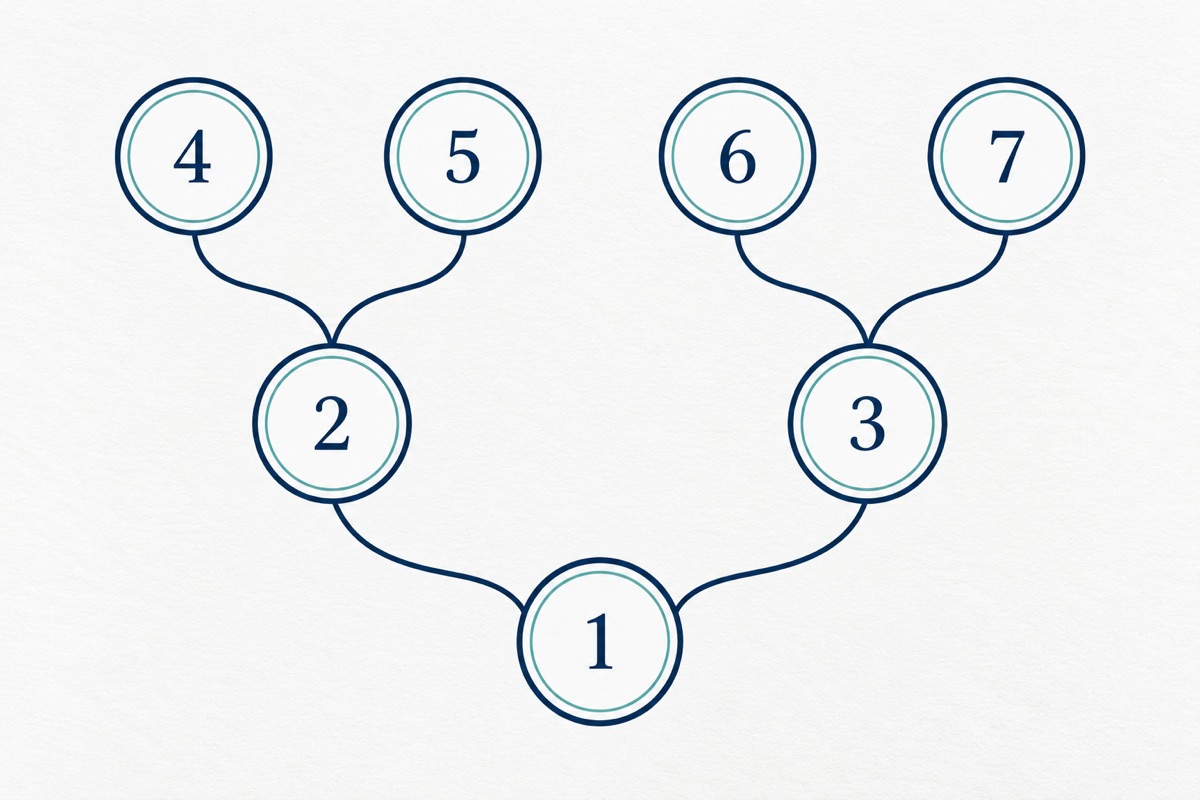
Numbering by Kekulé, also called the Sosa-Stradonitz system, rests on a simple rule. The person under study carries number 1, the father number 2 and the mother number 3. For a person with number n, the father gets number 2n and the mother number 2n+1.
This formula holds for every further number. It works because an even number marks the father and an odd number, apart from 1, marks the mother. The parents of the persons numbered 2 and 3 therefore carry the numbers 4 to 7.
The generation can also be read off the number. Number 1 belongs to the first generation, numbers 2 and 3 to the second and numbers 4 to 7 to the third. A single Kekulé number is thus enough to see a person's position in the ancestor table, even when the whole record is not at hand.
Where Does the Rule Come From, and What Is It Good For?
Michael Eytzinger described the principle in 1590. Jerónimo de Sosa spread it in 1676, and in 1898 Stephan Kekulé von Stradonitz applied it in his atlas of ancestor tables. That is where the two names come from, and both are used interchangeably.
Its practical use shows with larger collections. A family tree drawn as a diagram quickly becomes cluttered. Numbering turns that drawing into an orderly record that is easier to keep and read when many people are involved.
Gaps need attention too. If an ancestor is unknown, that number stays free. A missing entry does not shift the other people, so the record stays consistent even when data is incomplete. When new findings turn up, you simply add the entry under the free number.
Summary
The ancestor table leads upward, the descendant table downward, and the lineage list groups people with one surname. In Kekulé numbering of ancestors, each person gets a unique number from which their generation and the parent-child relationship can be read. Remembering the formula 2n and 2n+1 is enough to read any ancestor table kept in this scheme.